

Choosing the wrong cancellation policy is a revenue error that compounds with every booking. A policy that is too strict loses bookings to competitors who offer flexibility. A policy that is too lenient loses revenue to cancellations at the worst possible time. On Houfy, you set your own vacation rental cancellation policy without OTA restrictions — which means the decision is yours, and it matters more than most hosts realize.
Key Takeaways
Cancellation policy choice directly affects booking volume — flexible policies increase inquiry conversion by 15–30% in most markets
Strict policies protect peak-season revenue but reduce total booking volume in shoulder and off-peak periods
Moderate policies are the highest-performing default for most independent hosts — they balance conversion and protection
For holiday weekends (4th of July, Labor Day, Thanksgiving), a separate peak-season policy with stricter terms is worth setting
On Houfy, you set your cancellation policy directly with no OTA override — you own every term
Your cancellation policy should appear in your listing, your guest agreement, and your booking confirmation
Force majeure clauses protect both you and your guest when circumstances are genuinely outside anyone's control
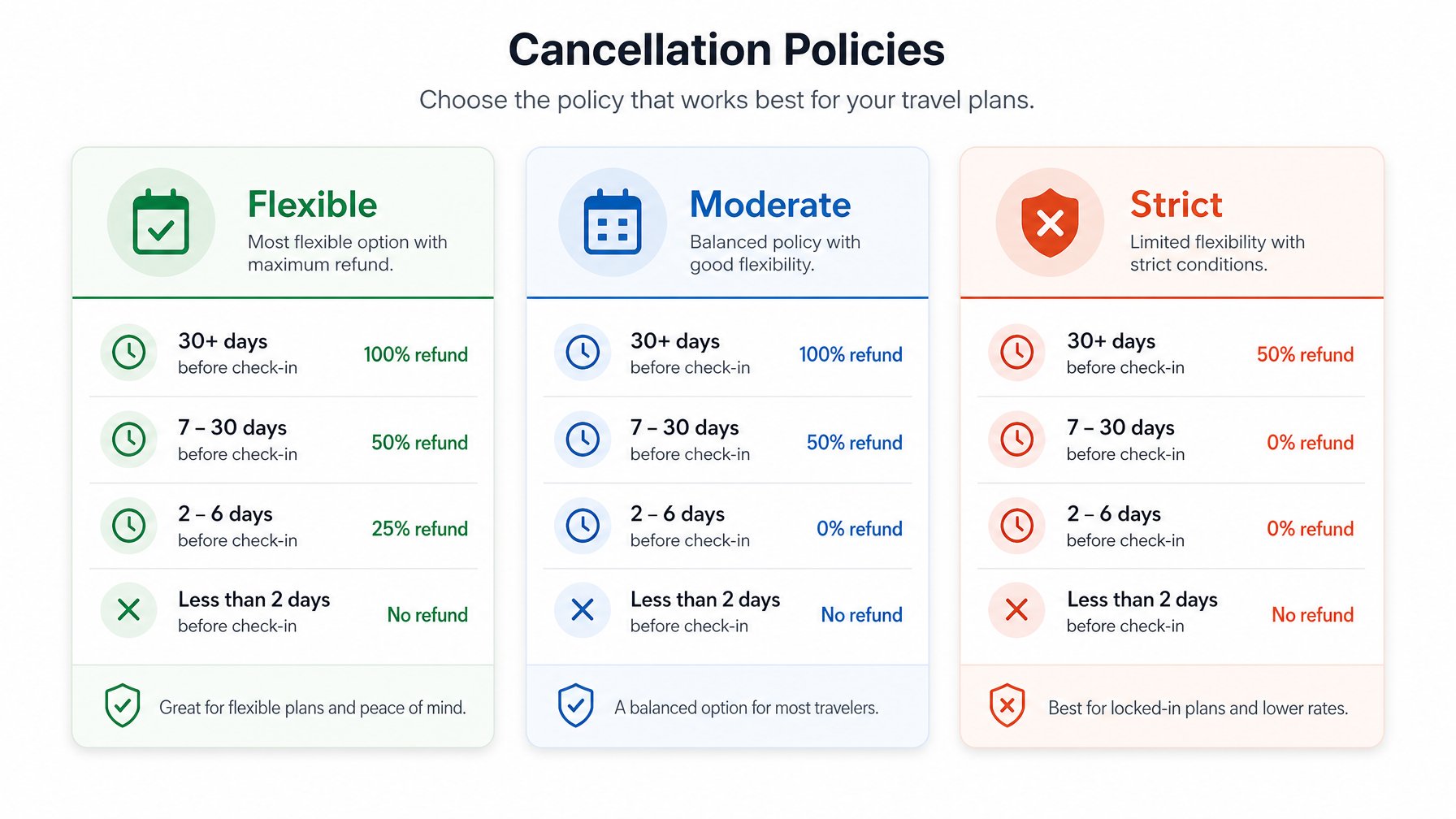
The Three Main Policy Types
Understanding the spectrum of vacation rental cancellation policies is the starting point for every host. Each policy type has a natural fit depending on your market, property type, and revenue goals.
Flexible
Full refund if the guest cancels more than 24–48 hours before check-in. Partial or no refund for very late cancellations.
Best for: urban and metro properties with high rebooking potential, last-minute booking markets, and properties priced at a premium where losing one booking is less costly than losing inquiry volume.
Risk: In rural or seasonal markets with thin booking demand, a last-minute cancellation leaves you unable to rebook and you earn nothing.
Moderate
Full refund if cancelled 5–14 days before check-in. 50% refund within the cancellation window. No refund within 48–72 hours of check-in.
Best for: most independent hosts in moderate-demand markets. Balances conversion with meaningful protection against cancellations in the critical week before check-in.
This is the policy that most direct booking hosts on Houfy use as their default — and for good reason. It gives guests enough confidence to book while protecting your income once the booking window closes.
Strict
Full refund only if cancelled 30+ days before check-in. 50% refund within 14–30 days. No refund within 14 days.
Best for: peak season bookings in high-demand markets, properties where rebooking capacity is limited, and luxury or high-rate properties where a single cancellation has significant revenue impact.
Caution: strict policies reduce inquiry conversion in off-peak periods. Apply strict terms selectively — for specific dates or seasons — rather than as a blanket policy year-round.
Ready to list your property on your own terms? List your property on Houfy and set your cancellation policy exactly as you choose — no platform override, no commission.
Peak Season Policy: Why You Need a Separate One
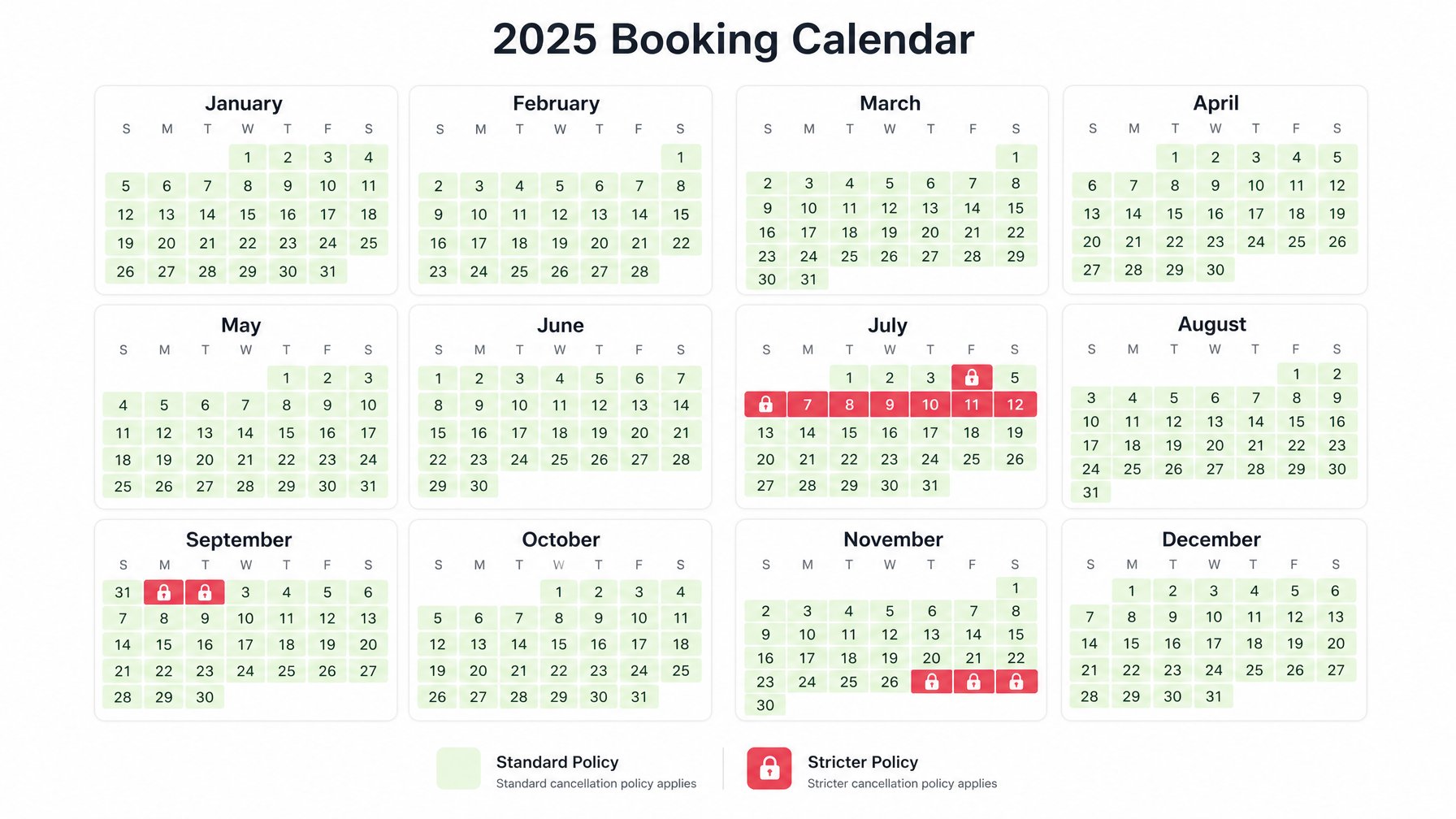
A single cancellation policy applied year-round is a compromise that serves no season well. The solution: a standard policy (Moderate) for most of the year and a stricter policy applied to your peak dates.
In your listing and short-term rental agreement, specify that cancellations for stays overlapping the following dates are subject to enhanced terms:
July 4th week — Independence Day weekend, a high-demand window with limited rebooking time
Labor Day weekend — final summer push, historically low rebooking rates after a cancellation
Thanksgiving week — domestic travel peak with advance bookings often placed months out
Local event dates — festivals, sporting events, conferences unique to your market
For peak periods: full refund 30+ days before check-in; 50% refund 14–30 days; no refund within 14 days.
On Houfy, you can communicate this directly in your listing description and include it explicitly in your guest agreement. No platform approval required. This is one of the core advantages of direct booking — your vacation rental house rules and cancellation terms are entirely in your hands.
Force Majeure and Emergency Cancellations

Include a force majeure clause in your guest agreement that specifies your policy for emergency or unavoidable cancellations — natural disasters, government-ordered travel restrictions, or verifiable medical emergencies.
On OTA platforms, emergency cancellation policies are platform-determined — hosts have no say. On Houfy, you set your own emergency policy. A standard framework most hosts use:
Government-ordered restrictions: Full refund for travel bans or government-ordered restrictions affecting travel to or from the property location. This is the one scenario where a full refund is almost universally expected by guests and is the right call for your reputation.
Documented medical emergencies: Case-by-case consideration, with documentation required. Most hosts offer a full or partial credit for rebooking rather than a cash refund.
Change of plans: No modification, regardless of the reason stated. "Change of plans" circumstances — including personal schedule conflicts, job changes, and relationship issues — are not force majeure events and your policy should say so clearly.
The key is having the policy written in your short-term rental agreement before a cancellation happens. Verbal agreements after the fact are unenforceable and create the conditions for disputes and negative reviews.
What to Do When a Guest Cancels
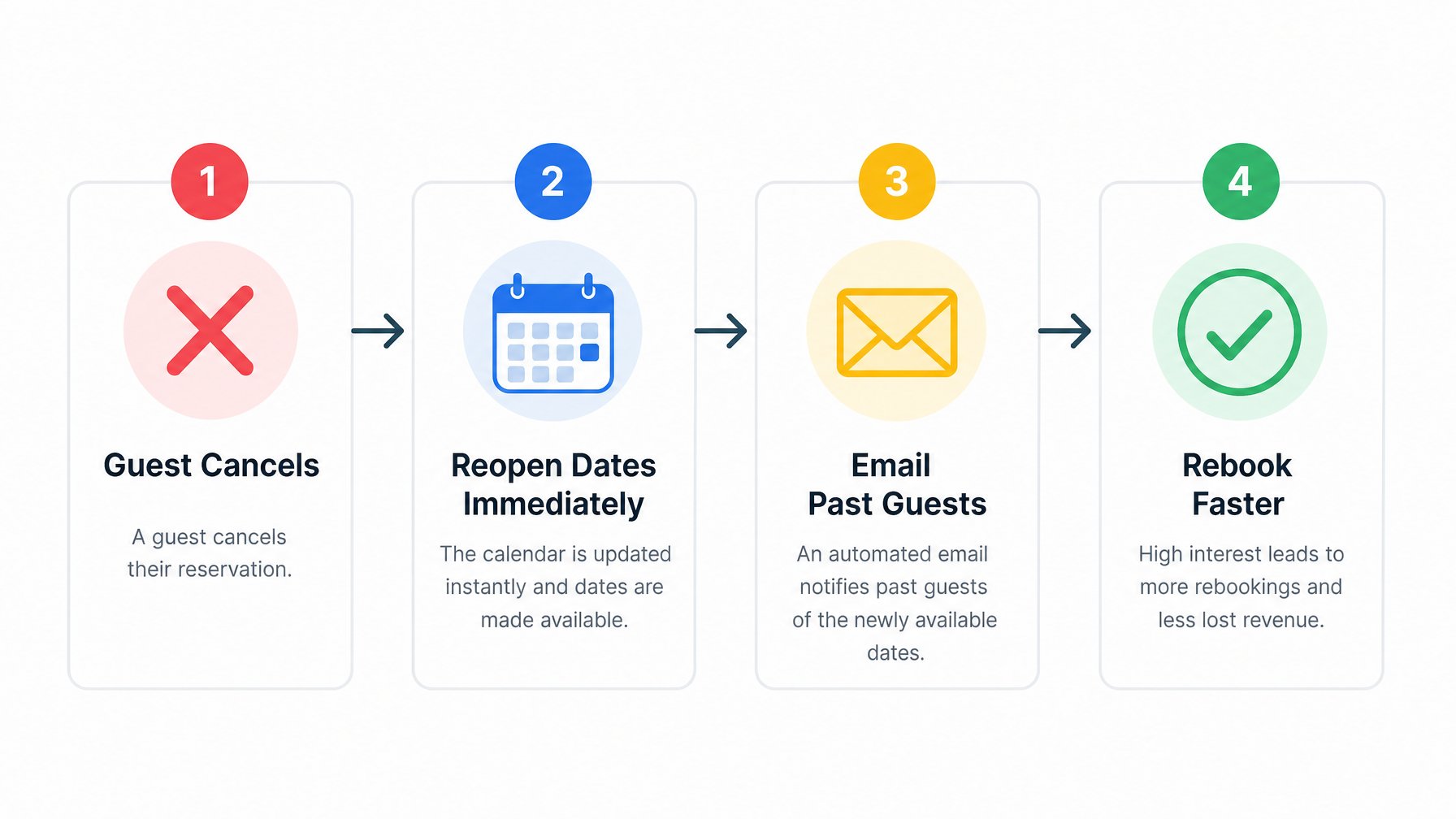
When a guest cancels a booking, execute this sequence immediately:
Step 1 — Reopen dates within the hour. Open the calendar on all platforms the moment you receive the cancellation notice. Every hour the dates stay blocked is an hour you cannot recover.
Step 2 — Reach out to past guests directly. Send a brief note to guests who have stayed during the same season in prior years: "We just had a cancellation open up — [dates] are now available if your plans are flexible." A direct reach-out to past guests fills cancellation windows at a much higher rate than relying on new search traffic alone. This is the direct booking advantage that OTAs structurally cannot replicate.
Step 3 — Review your minimum stay policy. A cancellation mid-season may leave dates that don't fit your standard minimum stay. Consider temporarily relaxing your minimum stay policy for the specific dates to maximize rebooking speed.
Step 4 — Handle refund exceptions carefully. If the cancellation is within your non-refund window and the guest requests an exception: evaluate based on the guest's history with you (repeat booker vs. first-timer), the likelihood of rebooking the dates, and whether granting a partial exception maintains a relationship worth having. A partial credit for a future stay is often a better outcome than a cash refund — it returns revenue rather than removing it.
Communicating Your Policy to Guests

Your cancellation policy is only as effective as your guests' awareness of it. The policy must appear in three places:
Your listing description — summarize your cancellation terms in a dedicated section near the top of your listing. Guests read cancellation policies before booking; hosts who bury them in fine print invite disputes.
Your guest agreement — include the full policy text, including peak-season variations and the force majeure clause, in the agreement guests sign before their stay. A signed agreement is your protection against chargebacks and payment disputes.
Your booking confirmation — include a one-paragraph summary of the cancellation terms in every confirmation message you send. This is the moment guests are most focused on the details of their booking.
Getting started with Houfy includes setting up your listing with full policy control from day one. The getting started guide for vacation rental hosts walks through every policy field step by step.
Take control of your cancellation policy. Join Houfy and set your own terms — flexible, moderate, or strict — without any platform telling you otherwise.
Frequently Asked Questions
Can I change my cancellation policy after a guest has booked?
No. The policy the guest agreed to at booking is binding. Changes apply to future bookings only. This is why your policy must be correct before you open your calendar — review it at the start of each season, not after a cancellation creates a problem.
What is the difference between a flexible and moderate cancellation policy?
A flexible policy gives guests a full refund up to 24–48 hours before check-in, which maximizes inquiry conversion but leaves you exposed to last-minute cancellations with no time to rebook. A moderate policy requires cancellation 5–14 days out for a full refund, which provides a meaningful buffer — enough time to remarket the dates — while still being competitive for most markets. For the majority of independent hosts, moderate is the better-performing default.
Should I offer travel insurance to offset a strict cancellation policy?
Yes. Several providers — including InsureMyTrip and Travel Guard — offer guest-facing travel insurance that covers trip cancellation for qualifying reasons. Mentioning these options in your listing and booking confirmation gives guests a way to protect themselves without requiring you to take on the cancellation risk. A strict policy combined with a clear travel insurance recommendation is a professional, guest-friendly setup.
Do I need to include my cancellation policy in my guest agreement?
Yes, and this is non-negotiable for direct booking hosts. The cancellation policy in your guest agreement is what makes it enforceable. If a guest files a payment dispute or chargeback, your signed agreement — with the cancellation terms clearly stated — is your primary evidence. Without it, you are relying on goodwill. With it, you have documentation.
What happens if I need to cancel on a guest?
Host-initiated cancellations are the most damaging event in direct booking. They destroy trust, generate negative reviews, and can damage your reputation on Google search. Always have a contingency — a trusted neighbor with property access, an emergency repair contact who can respond same-day — before accepting bookings. Your guest agreement should specify your terms if the property becomes uninhabitable due to circumstances genuinely outside your control, and should commit to a full refund in that scenario. That commitment costs you nothing when everything works, and protects your reputation when it doesn't.
How do I handle partial refunds without creating disputes?
State the exact refund amount — not a percentage — in your guest agreement wherever possible. "50% of the total booking value" creates clarity; "partial refund" does not. When issuing a partial refund, send the guest a written message that references the policy they agreed to and confirms the exact amount being returned. A clear paper trail ends disputes before they escalate.
Start with the right setup. Houfy gives you full cancellation policy control from day one. List your property and keep 100% of what you earn.
Source Citations
Houfy Host Resources and Booking Terms — https://www.houfy.com/become-a-host
InsureMyTrip — Vacation Rental Travel Insurance Options — https://www.insuremytrip.com
Travel Guard — Trip Cancellation Insurance for Vacation Rentals — https://www.travelguard.com
Vrbo Host Resources — Cancellation Policy Reference — https://www.vrbo.com/info/host-resources
Houfy currently has 98,000+ verified listings across 100+ countries.
Last Updated: June 27, 2026